$0.00099/GB. A Petabyte for $1,013/Month. But Retrieving It? That Is Where They Get You.
S3 Glacier Deep Archive is the cheapest storage service on any major cloud provider. One petabyte costs $1,013 per month. Read that number again. A million gigabytes for roughly the cost of a mid-range laptop.
At that price, the temptation is obvious: archive everything. Old logs? Glacier. Database backups? Glacier. Video assets from 2019? Glacier. Compliance records? Deep Archive. It costs almost nothing to keep.
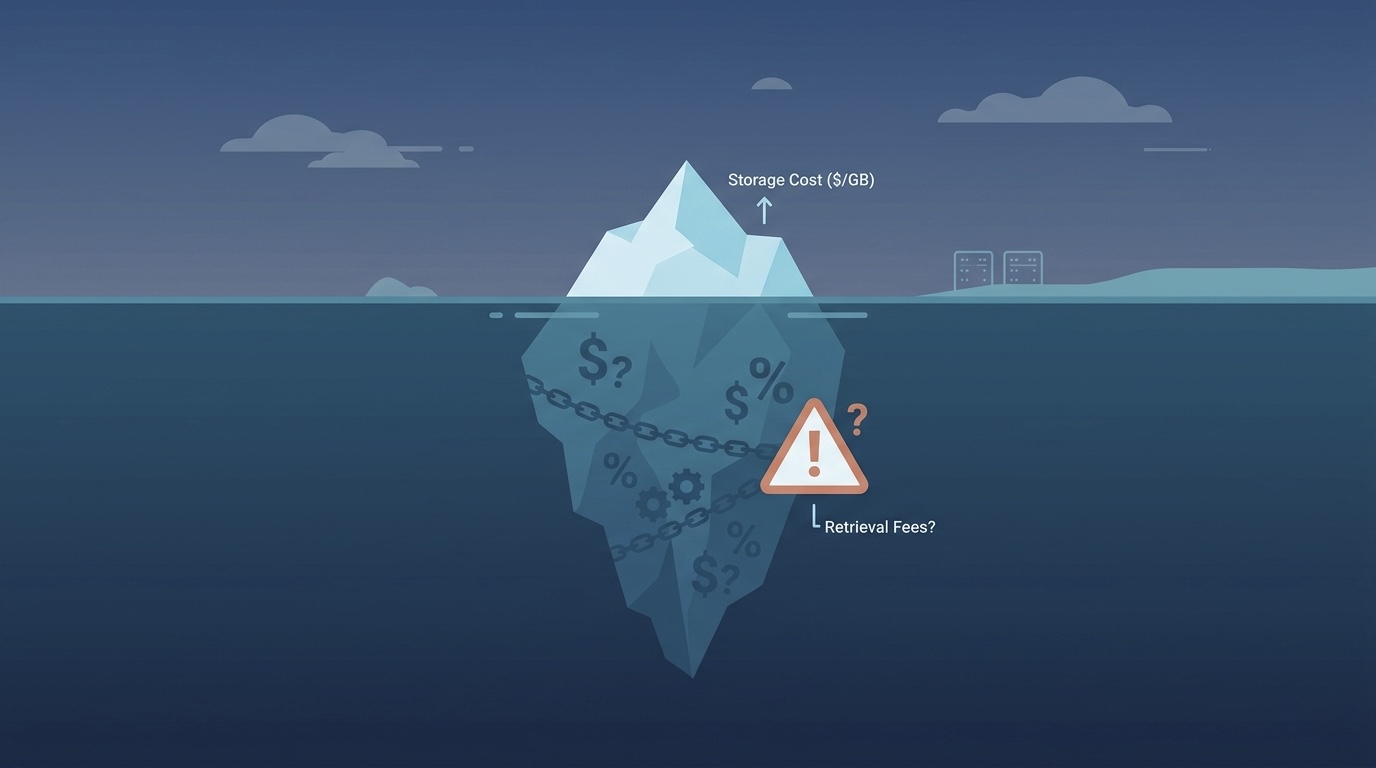
The problem arrives the day you need something back. Restoring 10TB from Deep Archive takes 12 hours minimum and costs $200 in retrieval fees. Need it faster? Expedited restore is not available on Deep Archive. Want your 100TB compliance archive back for an audit? That is $2,000 in retrieval plus half a day of waiting, plus egress if it leaves AWS.
Glacier pricing is designed for data that goes in and rarely (ideally never) comes out. Understand that trade-off and it is genuinely the best value in cloud storage. Misunderstand it and you will pay more in surprise retrieval fees than you saved on storage.
We regularly help teams optimize their cold storage strategies at LeanOps. The common pattern: a lifecycle rule dumps everything older than 30 days into Glacier Flexible Retrieval, then analysts need that data weekly and trigger $500+/month in restore fees. The fix is almost always Intelligent-Tiering or a more thoughtful lifecycle policy. This post gives you the complete Glacier pricing in 2026, honest cost modeling at scale, and the decision framework for choosing the right cold storage tier.
S3 Glacier Storage Tiers: Complete 2026 Pricing
AWS offers three Glacier-class tiers plus one automatic tier that includes archive access. Each trades retrieval speed for storage cost.
Storage Rates (US East, N. Virginia)
| Storage Tier | Cost per GB/month | Cost per TB/month | Min Duration | Access Latency |
|---|---|---|---|---|
| S3 Glacier Instant Retrieval | $0.004 | $4.10 | 90 days | Milliseconds |
| S3 Glacier Flexible Retrieval | $0.0036 | $3.69 | 90 days | 1 min to 12 hours |
| S3 Glacier Deep Archive | $0.00099 | $1.01 | 180 days | 12 to 48 hours |
| S3 Intelligent-Tiering (Archive tier) | $0.0036 | $3.69 | None | 3-5 hours (auto) |
| S3 Intelligent-Tiering (Deep Archive) | $0.00099 | $1.01 | None | 12 hours (auto) |
Key distinction: Objects in Intelligent-Tiering's archive tiers are automatically restored at no retrieval charge when accessed. Objects in Glacier (placed via lifecycle rules or direct upload) incur retrieval fees.
Retrieval Pricing
This is where Glacier gets expensive if you access data frequently.
| Tier | Expedited | Standard | Bulk |
|---|---|---|---|
| Glacier Instant Retrieval | N/A (always instant) | $0.03/GB (per GET) | N/A |
| Glacier Flexible Retrieval | $0.03/GB (1-5 min) | $0.01/GB (3-5 hours) | $0.0025/GB (5-12 hours) |
| Glacier Deep Archive | Not available | $0.02/GB (12 hours) | $0.0025/GB (48 hours) |
Plus per-request charges:
| Tier | Retrieval Request Cost |
|---|---|
| Glacier Instant Retrieval | $0.10 per 1,000 GET requests |
| Glacier Flexible (Expedited) | $10.00 per 1,000 requests |
| Glacier Flexible (Standard) | $0.05 per 1,000 requests |
| Glacier Flexible (Bulk) | $0.025 per 1,000 requests |
| Deep Archive (Standard) | $0.10 per 1,000 requests |
| Deep Archive (Bulk) | $0.025 per 1,000 requests |
Minimum Storage Duration Charges
This is the cost most teams overlook. If you delete or transition an object before the minimum duration, you pay for the full minimum period anyway.
| Tier | Minimum Duration | Effective Cost If Deleted Early |
|---|---|---|
| Glacier Instant Retrieval | 90 days | Object stored for 30 days still charged for 90 days ($0.012/GB total) |
| Glacier Flexible Retrieval | 90 days | Object stored for 30 days still charged for 90 days ($0.0108/GB total) |
| Glacier Deep Archive | 180 days | Object stored for 30 days still charged for 180 days ($0.00594/GB total) |
Practical example: You archive 1TB to Deep Archive, then delete it 60 days later. You pay: 180 days x $0.00099/GB x 1,024 GB = $5.50 total (not just 60 days worth). At Deep Archive's low rate this is minor, but at Glacier Instant ($0.004/GB) on larger datasets, early deletion penalties add up fast.
Additional Costs
| Operation | Cost | Notes |
|---|---|---|
| PUT/COPY/POST requests | $0.05 per 1,000 | All Glacier tiers |
| Lifecycle transition | $0.05 per 1,000 objects | S3 Standard to any Glacier |
| Object overhead | 32KB metadata + 8KB index per object | Billed at S3 Standard rate |
| Restore request (temporary copy) | See retrieval pricing above | Copy exists for 1-30 days |
| Egress (to internet) | $0.09/GB (standard rates) | Same as all S3 |
| Egress (to CloudFront) | Free | Use CF for large restores |
The 40KB overhead trap: Every Glacier object stores 32KB of metadata (at S3 Standard rate: $0.023/GB) and 8KB of index data (at Glacier rate). For millions of small files (log files, thumbnails), this overhead can exceed the actual storage cost. A 1KB file in Deep Archive effectively costs: 1KB at $0.00099/GB + 32KB at $0.023/GB + 8KB at $0.0036/GB = dominated by the 32KB overhead.
Rule of thumb: Do not archive objects smaller than 128KB individually. Aggregate them into tar/zip archives first.
Real-World Cost Modeling: Cold Storage at Scale
Scenario 1: 10TB Compliance Archive (Write-Once, Read-Never)
A financial services company archiving 10TB of transaction records for 7-year regulatory compliance. Data is written once and ideally never accessed.
| Component | Calculation | Monthly Cost |
|---|---|---|
| Storage (Deep Archive) | 10,240 GB x $0.00099 | $10.14 |
| Lifecycle transitions (one-time) | 1M objects x $0.05/1K | $50 (one-time) |
| Annual retrieval (audit, 100GB) | 100 GB x $0.02 standard | $2/year |
| Monthly steady-state | $10.14/month |
10TB for $10/month. This is Glacier's sweet spot: data you are legally required to keep but will almost never access. Over 7 years, total cost: $852 + $50 transition + occasional retrieval = under $1,000 for 7 years of 10TB storage.
Comparison:
- Azure Archive: $10.14/month (identical pricing)
- Google Archive: $12.29/month (21% more expensive)
- Backblaze B2: $61.44/month (6x more, but free egress on retrieval)
- Wasabi: $71.68/month (7x more, but no retrieval fees)
Scenario 2: 100TB Media Archive (Occasional Retrieval)
A media company archiving 100TB of video assets. Old content is occasionally pulled for re-release, about 5TB retrieved per quarter.
| Component | Calculation | Monthly Cost |
|---|---|---|
| Storage (Glacier Flexible) | 102,400 GB x $0.0036 | $368.64 |
| Quarterly retrieval (5TB standard) | 5,120 GB x $0.01 x 4/12 | $17.07 |
| Retrieval requests | 500K objects x $0.05/1K x 4/12 | $8.33 |
| Egress (to editing workstations) | 5,120 GB x $0.09 x 4/12 | $153.60 |
| Monthly total | ~$548/month |
Notice: retrieval fees ($17) are minor. Egress dominates at $154/month. If the editing workstations run on EC2 in the same region, egress is free and the monthly total drops to $394.
Why Flexible Retrieval instead of Deep Archive: 5TB quarterly retrieval with 12-hour waits is manageable but painful. Flexible Retrieval's standard 3-5 hour restore means the content team can request files in the morning and have them by lunch. Deep Archive would save $267/month in storage but add unpredictable 12-48 hour waits.
Scenario 3: 1PB Backup Repository (Disaster Recovery)
An enterprise storing 1PB of database backups and system images for disaster recovery. Full restore needed only in catastrophic failure (estimated once per 5 years).
| Component | Calculation | Monthly Cost |
|---|---|---|
| Storage (Deep Archive) | 1,048,576 GB x $0.00099 | $1,038 |
| Monitoring (optional) | Included | $0 |
| Full restore (if needed) | 1,048,576 GB x $0.02 | $20,972 (one-time) |
| Full restore egress | 1,048,576 GB x $0.05 (volume rate) | $52,429 (one-time) |
| Monthly steady-state | $1,038/month |
A petabyte for $1,038/month. But a full DR restore costs $73,401 in retrieval + egress. This is the fundamental Glacier economics: incredible storage value with expensive retrieval that discourages frequent access.
Critical DR planning note: A full 1PB restore from Deep Archive takes 48 hours (bulk) minimum. If your RTO is under 12 hours, Deep Archive is not your DR tier. Use Glacier Instant Retrieval for data that needs immediate DR access, or keep a warm standby on S3 Standard/Infrequent Access.
S3 Glacier vs Intelligent-Tiering: When to Use Each
This is the most common decision teams get wrong. Here is the framework:
Use Lifecycle Rules to Glacier When:
- Data has a predictable retention pattern ("never accessed after 90 days")
- You are confident retrieval will be rare (less than once per year)
- You want the absolute lowest storage cost
- You accept retrieval fees as a reasonable trade-off
- Example: compliance archives, old backups, decommissioned project data
Use S3 Intelligent-Tiering When:
- Access patterns are unpredictable ("some old data gets accessed, we do not know which")
- Data is occasionally accessed months after creation
- You want zero retrieval fees (IT auto-restores at no charge)
- You accept the small monitoring fee ($0.0025/1,000 objects/month)
- Example: analytics data, old logs that investigators occasionally query, media libraries
Cost Comparison: 100TB for 1 Year
| Strategy | Monthly Storage | Retrieval Cost (1TB/quarter) | Annual Total |
|---|---|---|---|
| Glacier Flexible + lifecycle | $369 | $40/quarter ($160/year) | $4,588 |
| Intelligent-Tiering (archive access) | $369 + $2.56 monitoring | $0 | $4,459 |
| Glacier Deep Archive + lifecycle | $101 | $80/quarter ($320/year) | $1,532 |
| IT with Deep Archive access enabled | $101 + $2.56 monitoring | $0 | $1,243 |
Intelligent-Tiering with Deep Archive access enabled saves money if you access archived data even once per year. The monitoring fee ($2.56/month for 100TB at 1M objects) is trivial compared to retrieval fees.
Cross-Cloud Cold Storage Comparison 2026
For teams evaluating cold storage across providers:
| Provider/Tier | Storage/GB/month | Retrieval Fee | Min Duration | Restore Time | Egress |
|---|---|---|---|---|---|
| AWS Glacier Deep Archive | $0.00099 | $0.02/GB std | 180 days | 12-48 hours | $0.09/GB |
| AWS Glacier Flexible | $0.0036 | $0.01/GB std | 90 days | 3-12 hours | $0.09/GB |
| AWS Glacier Instant | $0.004 | $0.03/GB | 90 days | Milliseconds | $0.09/GB |
| Google Archive | $0.0012 | $0.05/GB | 365 days | Milliseconds | $0.12/GB |
| Google Coldline | $0.004 | $0.02/GB | 90 days | Milliseconds | $0.12/GB |
| Azure Archive | $0.00099 | $0.02/GB | 180 days | 1-15 hours | $0.087/GB |
| Azure Cool | $0.01 | $0.01/GB | 30 days | Milliseconds | $0.087/GB |
| Backblaze B2 | $0.006 | Free | None | Instant | Free |
| Wasabi | $0.0069 | Free | 90 days | Instant | Free |
Key insights:
- Cheapest pure storage: AWS Deep Archive and Azure Archive tie at $0.00099/GB
- Cheapest with free retrieval: Backblaze B2 at $0.006/GB (6x more storage, but zero retrieval and zero egress)
- Google's trap: Archive storage has a 365-day minimum and $0.12/GB egress. Total cost of ownership is often higher than AWS despite a similar storage rate.
- Best instant-access cold storage: AWS Glacier Instant Retrieval ($0.004/GB with millisecond access), but only for quarterly-access patterns
For a detailed comparison of these providers at hot storage tiers, see our cloud storage pricing comparison 2026.
The Total Cost Formula: Why Storage Rate Is Not Enough
The true cost of cold storage is:
Total Monthly Cost = Storage + Retrieval Fees + Egress + Request Charges + Early Deletion Penalties
Here is how 10TB on different providers compares when you retrieve 500GB per month:
| Provider | Storage (10TB) | Retrieval (500GB) | Egress (500GB) | Total/Month |
|---|---|---|---|---|
| AWS Glacier Flexible | $37 | $5 | $45 | $87 |
| AWS Deep Archive | $10 | $10 | $45 | $65 |
| Google Coldline | $41 | $10 | $60 | $111 |
| Google Archive | $12 | $25 | $60 | $97 |
| Azure Archive | $10 | $10 | $44 | $64 |
| Backblaze B2 | $61 | $0 | $0 | $61 |
| Wasabi | $71 | $0 | $0 | $71 |
Backblaze B2 wins on total cost for workloads with regular retrieval, despite being 6x more expensive per GB stored. Zero retrieval and zero egress fees fundamentally change the math once you start accessing data.
AWS Deep Archive wins only when retrieval is genuinely rare (less than 1% of stored data per month).
For more on Backblaze B2 pricing, see our Backblaze B2 pricing guide.
S3 Glacier Optimization: 6 Strategies
1. Aggregate Small Objects Before Archiving
The 40KB overhead per object means archiving millions of small files (logs, events, thumbnails) wastes money. A 1KB object costs more in metadata overhead than in actual storage.
Fix: Use a nightly job to tar/zip small files into larger archives (100MB-1GB each), then transition the archives to Glacier. This eliminates per-object overhead and reduces PUT request costs.
2. Enable Intelligent-Tiering with Archive Access
Instead of manual lifecycle rules to Glacier, enable S3 Intelligent-Tiering with archive access tiers enabled. Objects automatically move to archive after 90 days of no access, and auto-restore with zero fees when accessed.
Configuration: enable "Archive Access tier" (after 90 days) and optionally "Deep Archive Access tier" (after 180 days) on your IT bucket.
3. Use Bulk Retrieval for Non-Urgent Restores
Bulk retrieval from Deep Archive costs $0.0025/GB vs standard at $0.02/GB. That is an 87% discount for waiting 48 hours instead of 12.
For a 10TB restore: bulk costs $25.60, standard costs $204.80. If your restore is not time-sensitive (monthly analytics, historical research), always use bulk.
4. Restore to Same-Region EC2 (Avoid Egress)
When restoring Glacier data, process it on EC2 instances in the same region. Same-region data transfer between S3 and EC2 is free. If you download restored data to your office or another cloud, you pay the full $0.09/GB egress.
For a 5TB restore: processing on EC2 saves $460 in egress fees.
5. Set Appropriate Lifecycle Rules Based on Access Patterns
| Access Pattern | Recommended Tier | Why |
|---|---|---|
| Never accessed after 30 days | Deep Archive (after 30 days) | Cheapest possible storage |
| Rarely (1-2x/year) | Glacier Flexible (after 60 days) | Balance of cost and 3-5 hour restore |
| Quarterly | Glacier Instant (after 30 days) | Instant access at cold storage price |
| Unpredictable | Intelligent-Tiering | Auto-tiers with zero retrieval fees |
6. Monitor for Lifecycle Rule Conflicts
A common mistake: a lifecycle rule transitions objects to Glacier on day 30, then another rule transitions to Deep Archive on day 60. The object spends only 30 days in Glacier Flexible but is charged for the 90-day minimum, plus the Deep Archive transition creates another minimum duration clock.
Audit your lifecycle rules to ensure transitions do not trigger early deletion penalties.
Glacier Retrieval Cost Calculator by Urgency
This is the table you need when someone asks "how much will it cost to get our data back?" The answer depends entirely on how fast you need it and how much you are retrieving.
Cost to Retrieve from Glacier Flexible Retrieval
| Data Volume | Bulk (5-12 hours) | Standard (3-5 hours) | Expedited (1-5 minutes) |
|---|---|---|---|
| 1 TB | $2.56 | $10.24 | $30.72 |
| 10 TB | $25.60 | $102.40 | $307.20 |
| 100 TB | $256.00 | $1,024.00 | $3,072.00 |
| 1 PB | $2,560.00 | $10,240.00 | $30,720.00 |
Cost to Retrieve from Glacier Deep Archive
| Data Volume | Bulk (48 hours) | Standard (12 hours) | Expedited |
|---|---|---|---|
| 1 TB | $2.56 | $20.48 | Not available |
| 10 TB | $25.60 | $204.80 | Not available |
| 100 TB | $256.00 | $2,048.00 | Not available |
| 1 PB | $2,560.00 | $20,971.52 | Not available |
Total Cost Including Egress (If Data Leaves AWS)
This is the number that makes CFOs pause. Retrieval fees are only part of the bill. If the restored data needs to leave AWS (download to on-premises, transfer to another cloud, send to a partner), add egress:
| Data Volume | Retrieval (Deep Archive Standard) | Egress to Internet | Total to Get Data Out |
|---|---|---|---|
| 1 TB | $20.48 | $92.16 | $112.64 |
| 10 TB | $204.80 | $870.40 | $1,075.20 |
| 100 TB | $2,048.00 | $7,168.00 | $9,216.00 |
| 1 PB | $20,971.52 | $52,428.80 | $73,400.32 |
The savings hack: If you process restored data on EC2 in the same region, egress is $0. A 1PB restore processed in-region costs $20,972 instead of $73,400. That is a 71% reduction by keeping data inside AWS.
Expedited retrieval tip: Expedited is only available on Glacier Flexible Retrieval and requires provisioned retrieval capacity ($100/unit/month, each unit provides 3 expedited retrievals per 5 minutes up to 150MB). Without provisioned capacity, expedited requests can fail during peak demand. Budget $100-500/month if you need guaranteed sub-5-minute access.
The Archive Decision Framework: Which Tier Actually Saves You Money
The cheapest storage tier is NOT always the cheapest total cost. This framework tells you when each tier wins based on how often you access data.
Break-Even Analysis: When Standard Is Cheaper Than Glacier
The counterintuitive math: S3 Standard costs 23x more to store than Deep Archive ($0.023 vs $0.00099/GB). But Deep Archive charges $0.02/GB to retrieve. If you retrieve data frequently enough, the "cheap" tier becomes more expensive.
Break-even formula: If monthly retrieval percentage > (Standard storage cost - Archive storage cost) / Retrieval fee per GB
For Deep Archive vs Standard:
- Break-even: ($0.023 - $0.00099) / $0.02 = 1.1% per month
- If you retrieve more than 1.1% of your stored data per month, S3 Standard is cheaper than Deep Archive
For Glacier Flexible vs Standard:
- Break-even: ($0.023 - $0.0036) / $0.01 = 1.94% per month
- If you retrieve more than 2% of stored data per month, Standard is cheaper than Flexible Retrieval
For Glacier Instant vs Standard:
- Break-even: ($0.023 - $0.004) / $0.03 = 0.63% per month
- If you retrieve more than 0.63% of stored data per month, Standard is cheaper than Instant Retrieval
The Decision Matrix
| Access Pattern | Recommended Tier | Monthly Cost per TB | Why |
|---|---|---|---|
| Multiple times daily | S3 Standard | $23.00 | No retrieval fees, instant access |
| Weekly (2-5% monthly) | S3 Standard or Intelligent-Tiering | $23.00 or auto-optimized | Break-even favors Standard at this frequency |
| Monthly (0.5-2% retrieved) | S3 Standard-IA | $12.50 + $0.01/GB retrieval | Cheaper storage, minimal retrieval cost |
| Quarterly (< 0.5% monthly) | Glacier Instant Retrieval | $4.00 + $0.03/GB retrieval | 83% storage savings, millisecond access |
| Annually (< 0.1% monthly) | Glacier Flexible Retrieval | $3.60 + $0.01/GB retrieval | Can wait 3-5 hours for data |
| Near-never (compliance/DR) | Glacier Deep Archive | $1.01 + $0.02/GB retrieval | True cold storage, 12-48 hour restore |
| Unpredictable | S3 Intelligent-Tiering | Auto-optimized | Zero retrieval fees, auto-tiers based on access |
Annual Cost Comparison: 100TB at Different Access Frequencies
| Monthly Retrieval % | S3 Standard | Glacier Instant | Glacier Flexible | Deep Archive | IT (Archive) | Cheapest |
|---|---|---|---|---|---|---|
| 5% (5TB/month) | $27,600 | $22,560 | $10,428 | Not practical | $4,459 | IT |
| 2% (2TB/month) | $27,600 | $12,960 | $6,828 | Not practical | $4,459 | IT |
| 0.5% (500GB/month) | $27,600 | $6,600 | $5,028 | $2,532 | $4,459 | Deep Archive |
| 0.1% (100GB/month) | $27,600 | $5,160 | $4,548 | $1,452 | $4,459 | Deep Archive |
| 0% (never) | $27,600 | $4,800 | $4,320 | $1,212 | $4,430 | Deep Archive |
Key insight: Intelligent-Tiering with Deep Archive access enabled is the winner for any data accessed between 0.5% and 5% monthly because it charges zero retrieval fees while using archive-tier storage rates. Below 0.5% access, manual Glacier Deep Archive with lifecycle rules saves the monitoring fee ($2.56/month per million objects) and wins on pure cost.
The Bottom Line
S3 Glacier Deep Archive is the cheapest cloud storage available at $0.00099/GB/month. For true write-once-read-never archives (compliance, backups, legal hold), nothing beats it on storage cost. But the total cost of ownership depends entirely on how often you need data back.
Three rules for Glacier success:
- If retrieval is rare (less than 1% of data per month), Glacier Deep Archive saves massively
- If access patterns are unpredictable, Intelligent-Tiering with archive access is cheaper than Glacier + retrieval fees
- If you retrieve data regularly, Backblaze B2 ($0.006/GB, zero retrieval) is often cheaper than Glacier in total cost
If your S3 storage bill is growing and you are unsure whether lifecycle rules or Intelligent-Tiering is the right approach, our team at LeanOps specializes in AWS storage cost optimization. We typically cut S3 bills by 30-50% within 30 days by implementing the right tiering strategy. Get a free Cloud Waste Assessment to see how much your cold storage could save.
Further reading: